

The Dream

Close your eyes for a moment.
Picture the child you are carrying — or the child you are calling in. Picture who you want them to be.
Calm in the face of chaos. Kind without being asked. Confident without being cruel. Curious about the world. Rooted in their identity. Connected to something larger than themselves.
Every mother carries this dream. It lives in the quiet moments — in the way you rub your belly before sleep, in the prayers you whisper, in the songs you hum without knowing why.
You want to give your child the world.

But what if the most important world you can give them — is the world inside you?
The Truth Our Tradition Always Knew
In our Vedic tradition, the mother is not just a vessel. She is the first guru.
Matru Devo Bhava — the mother is God. Not because she is perfect. But because she is the first face of the divine a child ever knows.
The Ramayana shows us this truth in Sita — a mother who carried Lava and Kusha through exile, hardship, and unimaginable grief, yet never let her inner light go dark. Her sons did not inherit her circumstances. They inherited her character.
Ayurveda speaks of Garbhini Paricharya — the complete care of the pregnant woman — not just her body, but her mind, her emotions, her spiritual state. Ancient texts prescribed what she should eat, what she should see, what thoughts she should cultivate. Why? Because they understood something we are only now proving in laboratories.

Our ancestors did not need science to know that the mother shapes the child. They built an entire tradition around it.
What Science Now Confirms
Epigenetics — the study of how environment influences gene expression — has revealed something extraordinary: your baby's genes are not fixed. They are being switched on and off right now, in response to the emotional environment of your womb.
When you experience chronic stress, cortisol floods your system — and your baby's. Research shows that elevated prenatal cortisol is linked to higher anxiety, lower resilience, and difficulty with emotional regulation in children — not because of anything they did, but because of what they absorbed.
Mirror neurons — the same brain cells that allow babies to imitate facial expressions moments after birth — begin developing in the womb. Your baby is already practising being you.
Perinatal psychologist Dr. Thomas Verny documented that babies in the womb respond to their mother's voice, her music, her emotional states — forming the first imprints of who they will become.

The womb is not a waiting room. It is the most formative classroom your child will ever enter. And you are already teaching.
The Invitation to Transform
This is not about being a perfect mother. There is no such thing.
This is about becoming a conscious one.
It means choosing, day by day, to heal what was handed to you — so you do not hand it on. It means learning to regulate your nervous system — not just for yourself, but for the tiny being whose nervous system is being built from yours. It means filling your inner world with beauty, devotion, intention, and love — because that is the inheritance your child will carry for a lifetime.
Transformation does not require perfection. It requires presence.
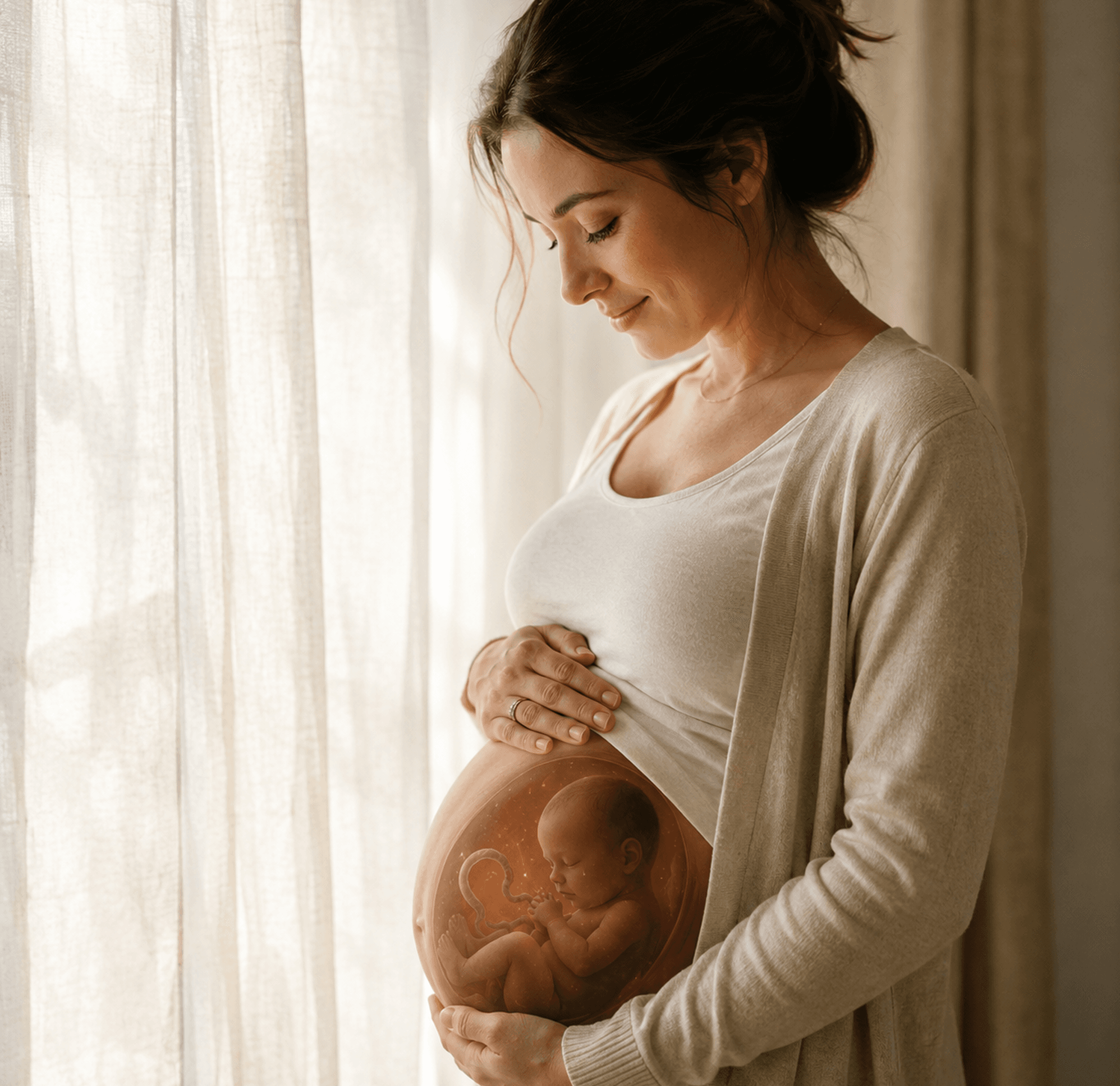
It requires the willingness to say: I will be different. Not because I was wrong — but because my child deserves my best, and my best is still becoming.
What This Looks Like Every Day
Inside SishuSamskaara, transformation is not abstract. It is a daily practice — small, sacred, and cumulative.
- A morning affirmation rooted in the Navadurga — nine divine qualities awakened one by one across your pregnancy.
- A breathwork practice that signals safety to your nervous system and your baby's.
- A weekly immersion into the Sita journey — six sacred phases of conscious pregnancy drawn from the Ramayana.
- The Hanuman Chalisa as a vibrational offering — forty verses, forty weeks, devotion woven into every cell.
- Ayurvedic practices for each trimester — what to eat, how to rest, how to move, how to think.
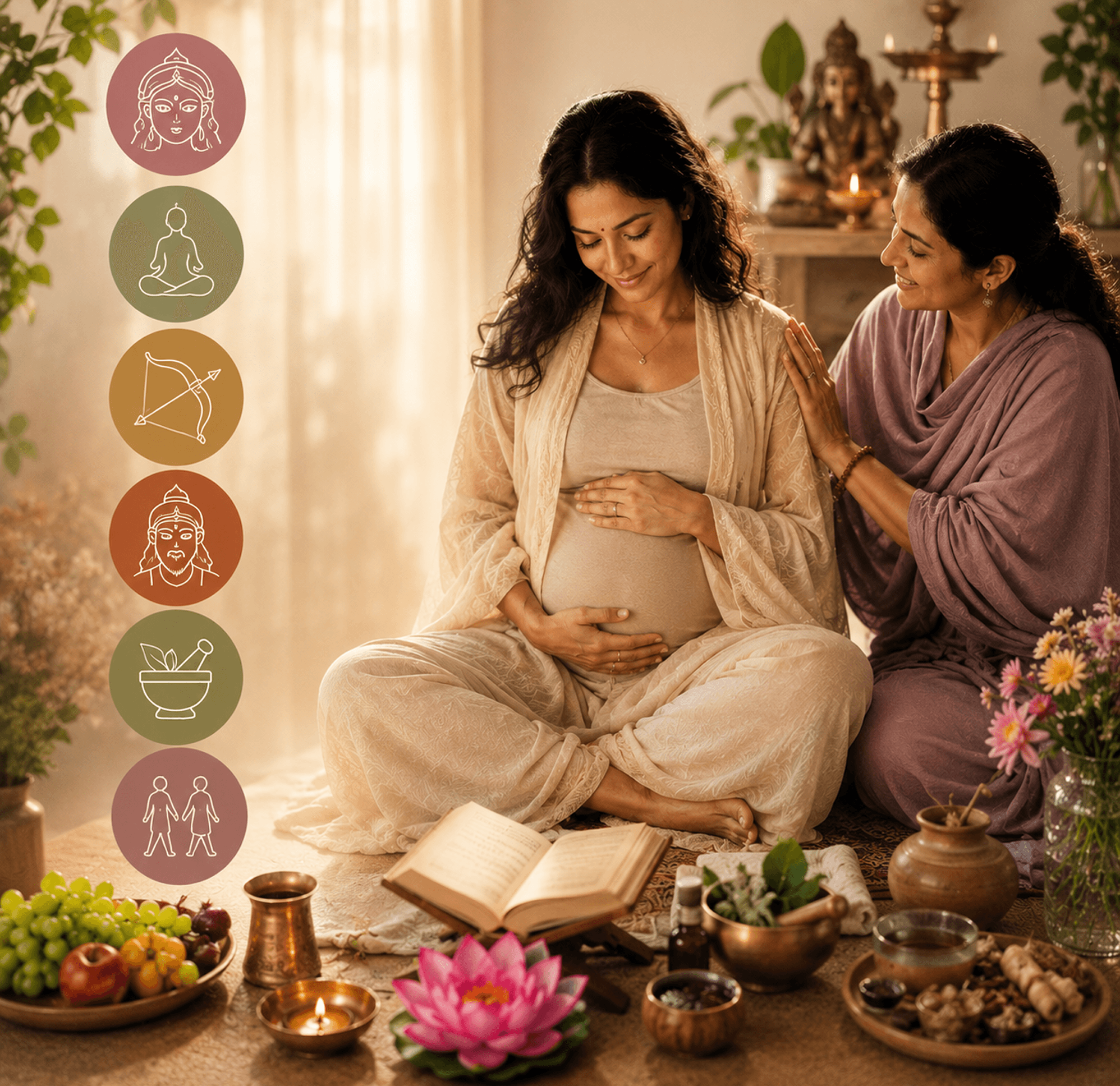
And through it all — a guide who walks beside you. Not ahead of you. Beside you.